Fiscal Transparency and Sustainability

Public budget meetings are underway. View the Resident Budget Task Force (RBTF) report and the Fiscal Year 2026-2027 Preliminary Budget report to that were delivered at the May 11 City Council meeting. 

Overview

The City of Cerritos is committed to responsibly managing our public resources that support our long-term financial goals and strengthen our future. This commitment to fiscal transparency and sustainability is prioritized in our Strategic Plan and is symbolic of our Cerritos in Progress theme. We invite Cerritos residents to engage in the Fiscal Year 2026-2027 Budget planning process. Through increased fiscal engagement, we’ll progress together in building a bright future for Cerritos.

Jump to:
Budget Meeting Dates | Budget News | Informational Charts | FAQs

Budget Meeting Dates

You’re invited to engage in the annual budget process and learn more about how the City operates.  The process includes multiple community workshops, City Council budget study sessions, and concludes with a public hearing and formal budget adoption. 

Upcoming Events

  • June 8, 2026: Budget Study Session #3; Cerritos City Council meeting
    • 7 p.m., City Council Chamber
  • June 22, 2026: Public Hearing and Budget Adoption; Cerritos City Council meeting
    • 7 p.m., City Council Chamber
  • July 1, 2026: Fiscal Year 2026-2027 begins

May 11, 2026: City Council meeting agenda

  • 9A: Review and consideration of a summary overview of the findings of the Resident Budget Task Force (COUNCIL).
  • 9B: Review and consideration of the Fiscal Year 2026-27 Preliminary Combined Financial Program for the City of Cerritos and the Successor Agency to the Cerritos Redevelopment Agency (COUNCIL/SUCCESSOR AGENCY).

May 5, 2026: City Council meeting agenda for May 11 published

  • 9A: Review and consideration of a summary overview of the findings of the Resident Budget Task Force (COUNCIL).
  • 9B: Review and consideration of the Fiscal Year 2026-27 Preliminary Combined Financial Program for the City of Cerritos and the Successor Agency to the Cerritos Redevelopment Agency (COUNCIL/SUCCESSOR AGENCY).

May 1, 2026: Preliminary FY26-27 Budget Book

  • The Preliminary City of Cerritos Combined Financial Program for 2026-2027 was published to the City's website.

April 21, 2026: Virtual Community Budget Workshop

April 15, 2026: Community Budget Workshop

April 3, 2026: Budget meeting mailers

  • Cerritos residents and businesses began receiving postcards in the mail inviting them to participate in upcoming community budget meetings. 

March 9, 2026: City Council meeting

  • 9B: Review and consideration of the City of Cerritos Annual Comprehensive Financial Report for Fiscal Year 2024-25.
  • 9C: Review and Consideration of the Fiscal Year 2025-2026 Midyear budget update and proposed Fiscal Year 2025-2026 Budget amendments. 

December 11, 2025: City Council meeting

  • 9A: Review and consideration of information related to the FY 2026-2027 budget development process and Strategic Plan update (Budget Study Session #1)

December 2025: Budget at a Glance mailed

  • A Budget at a Glance document was mailed to Cerritos residents in December 2025 to provide clarity on projected Citywide expenses and revenues for Fiscal Year 2025-2026. 
Budget News

News articles from the City of Cerritos on the budget process, key initiatives, and dates.  

Cerritos City Council to Receive Resident Budget Task Force Report, Hold Budget Study Session

May 7, 2026 - The Cerritos City Council will hear a report on the findings of the Resident Budget Task Force (RBTF) and hold a budget study session during its regular meeting on Monday, May 11. The 16-member task force met on four separate occasions between late March and late April to provide community input on the City's current budget climate and potential budget balancing strategies. Following review of the report, the City Council will engage in its latest Budget Study Session. In accordance with City Council direction, City staff prepared a dual budget for consideration for Fiscal Year 2026-2027. 

Read full story

Cerritos Hosts Community Budget Workshop, Additional Meetings Planned

April 16, 2026 - Information on Cerritos’ fiscal climate, financial forecasts, and budget considerations was shared during the first of two Community Budget Workshops on Wednesday, April 15. The meeting at the Cerritos Senior Center was facilitated by consultant Tripepi Smith and City staff. Budget workshops are intended to provide information to residents and facilitate feedback to inform the Fiscal Year 2026-2027 budget. 

Read full story

Community Invited to Series of Meetings on Cerritos’ Budget

April 7, 2026 - The City of Cerritos invites the community to participate in a series of meetings ahead of the Fiscal Year 2026-2027 Budget adoption. Meetings will focus on the City’s current fiscal climate, financial forecasts, and budget considerations. Participants will also have opportunities to share their feedback.

Read full story 

City Council Reviews Alternative Revenue Sources, Directs Dual Budget Planning Framework

March 11, 2026 - The Cerritos City Council on March 9 directed staff to conduct further evaluation of a potential 1% Transactions and Use Tax (TUT) that would support additional revenues and future water and sewer rate relief. The action followed a presentation by staff at the direction of the City Council on multiple alternative revenue sources. Among the alternative revenues evaluated at the meeting, a 1% TUT would generate substantially greater ongoing revenue than the others.

Read full story

Informational Charts

Fiscal Climate Overview

The City's Fiscal Climate handout (Updated for Fiscal Year 2026-2027) consists of budget meeting dates, informational charts on Cerritos revenues and expenditures, and forecasted revenues and expenditures. Charts can also be viewed individually through the dropdown sections below.  

Individual Charts

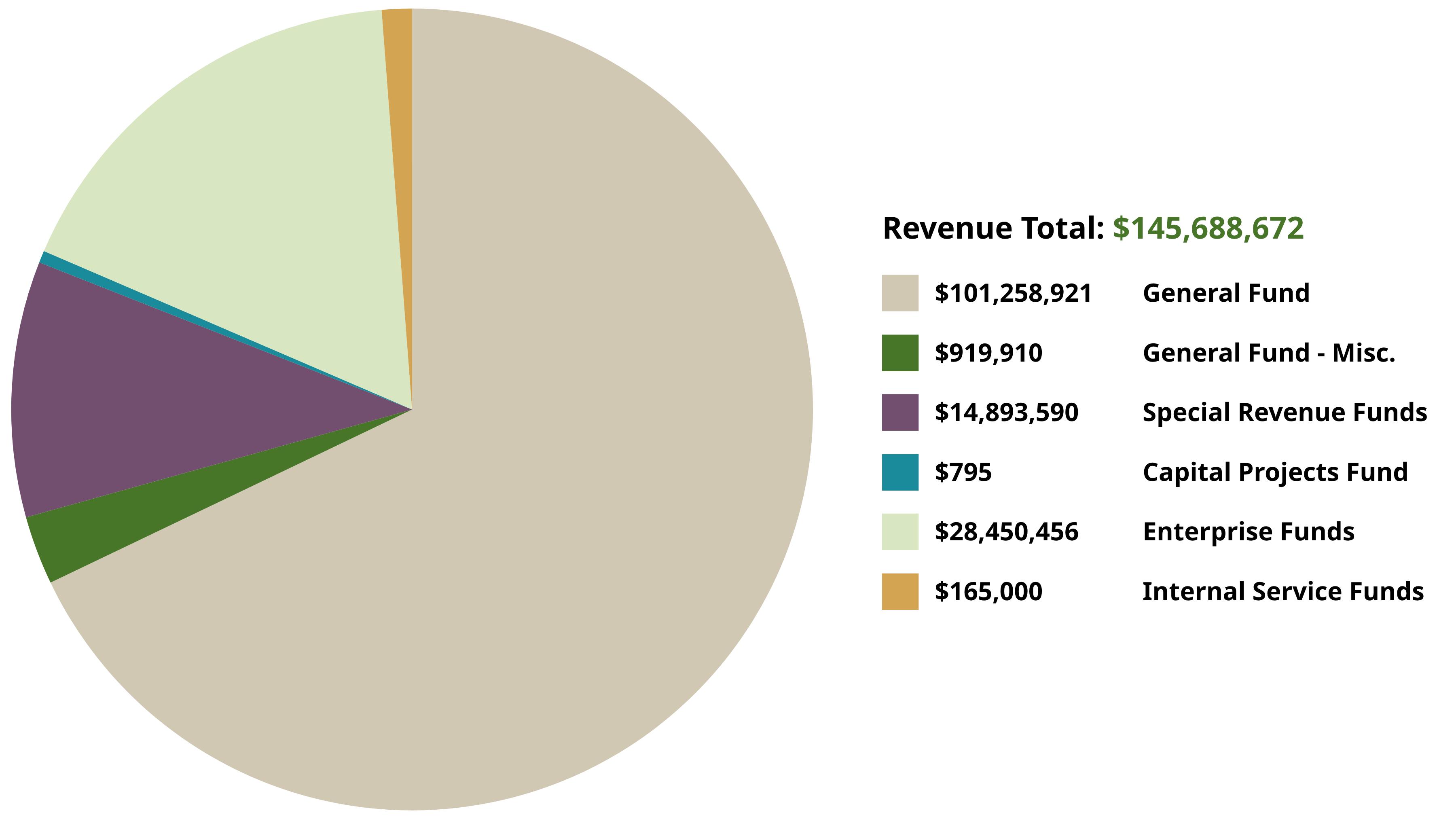
City of Cerritos revenues are comprised of six fund types. The General Fund accounts for the largest source of City revenue. 

Pie chart displaying citywide total revenues by fund type.

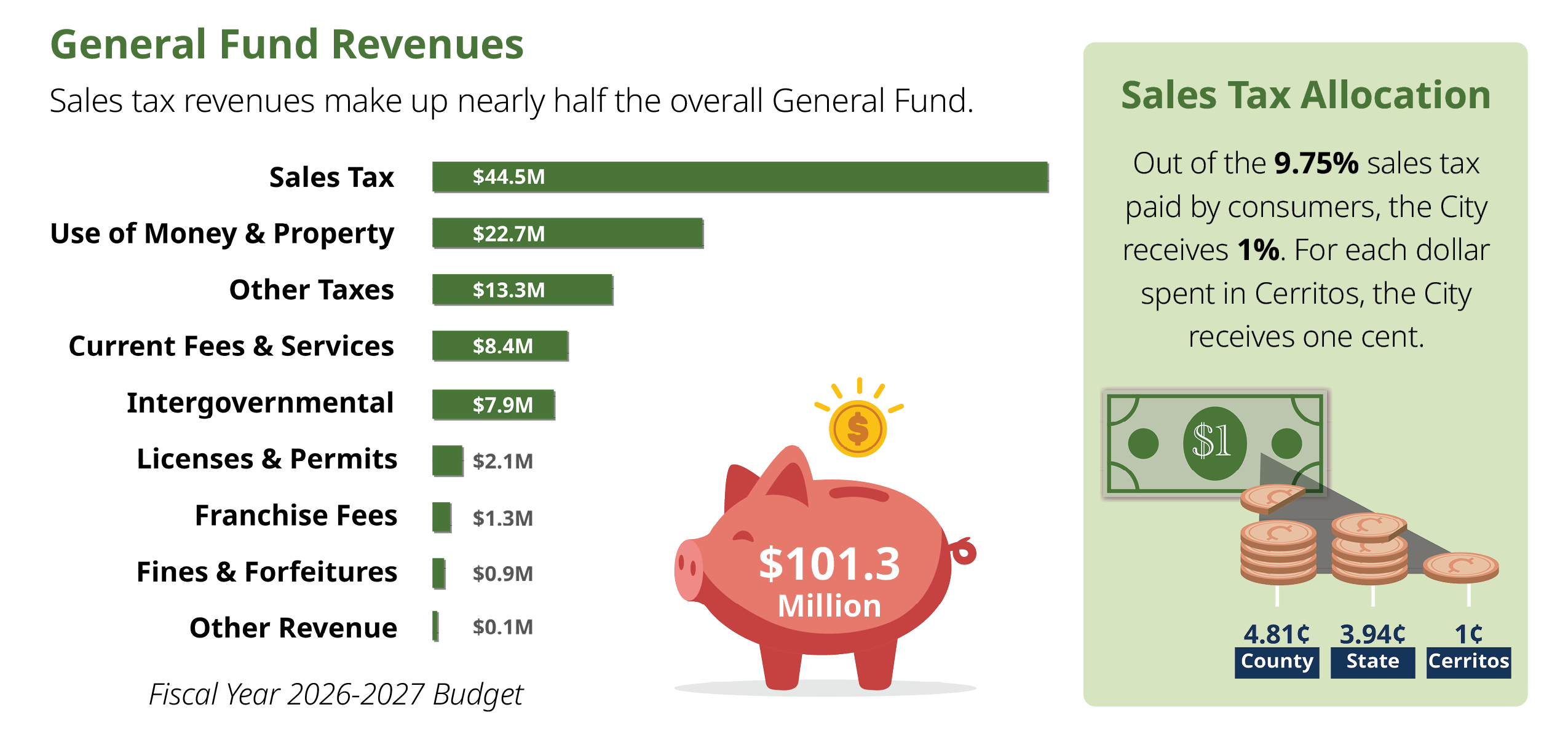
Sales tax revenues make up nearly half of the overall General Fund. Out of the 9.75% sales tax paid by consumers, the City receives 1%. For each dollar spent in Cerritos, the City receives one cent. 

Bar graph displaying General Fund revenues and City's stales tax allocation.

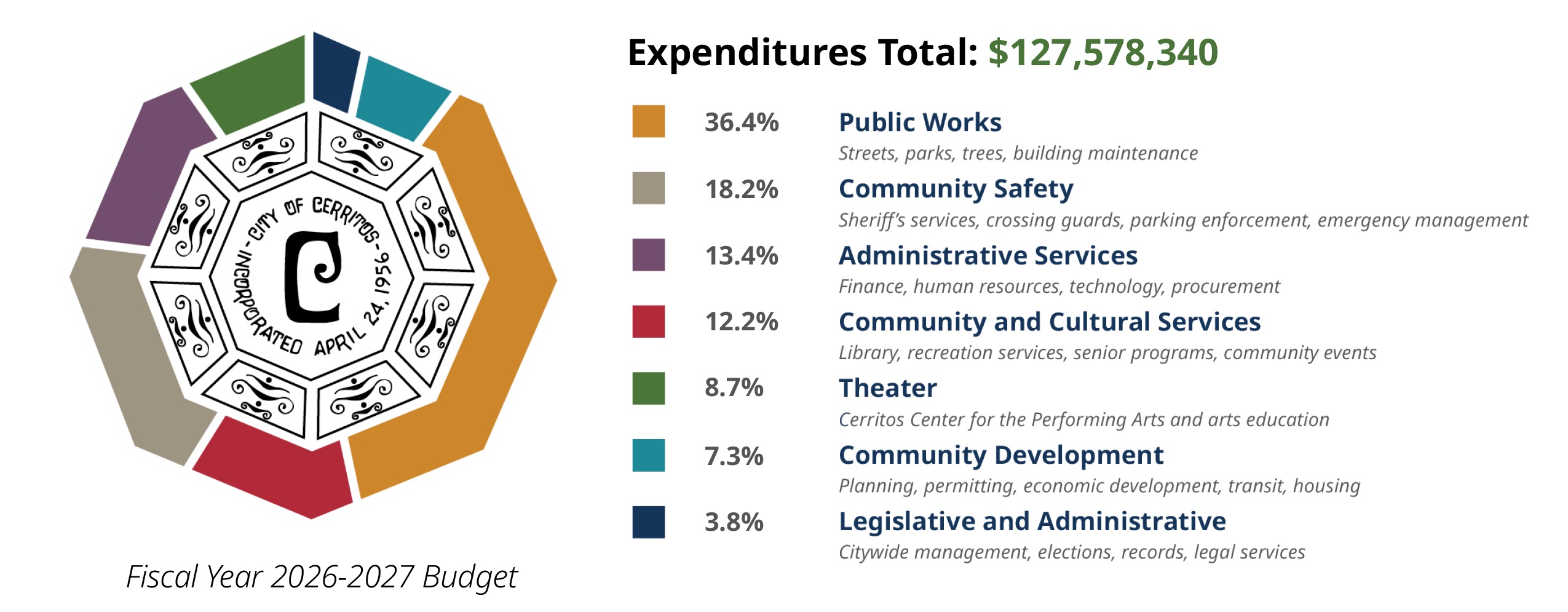
Citywide operating expenditures fund public safety, maintain infrastructure, support community amenities, and provide high quality services for residents. 

Pie chart displaying Citywide Operating Expenditures by Service Type.

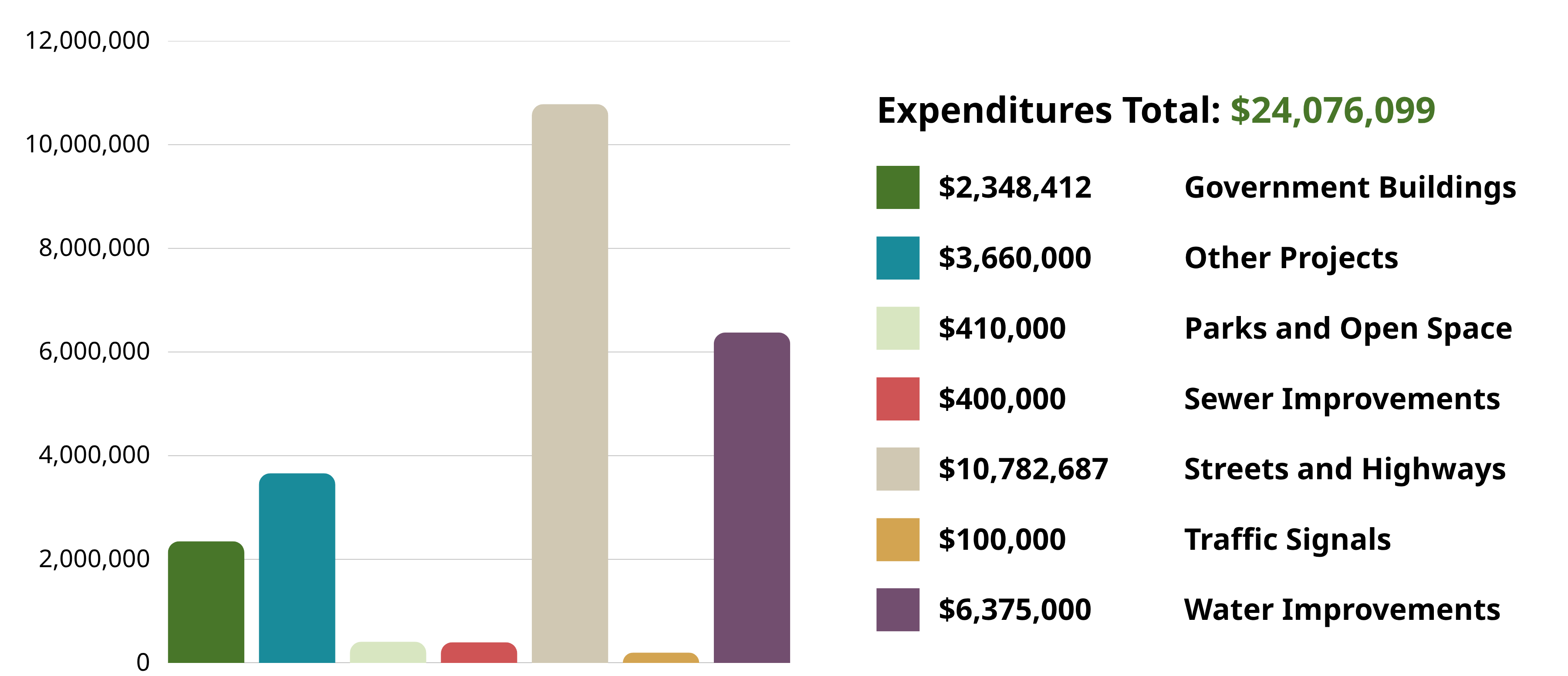
CIP projects are prioritized based on critical need and intended to support reasonable and controlled growth. 

Bar chart displaying Capital Improvement Program project allocations.

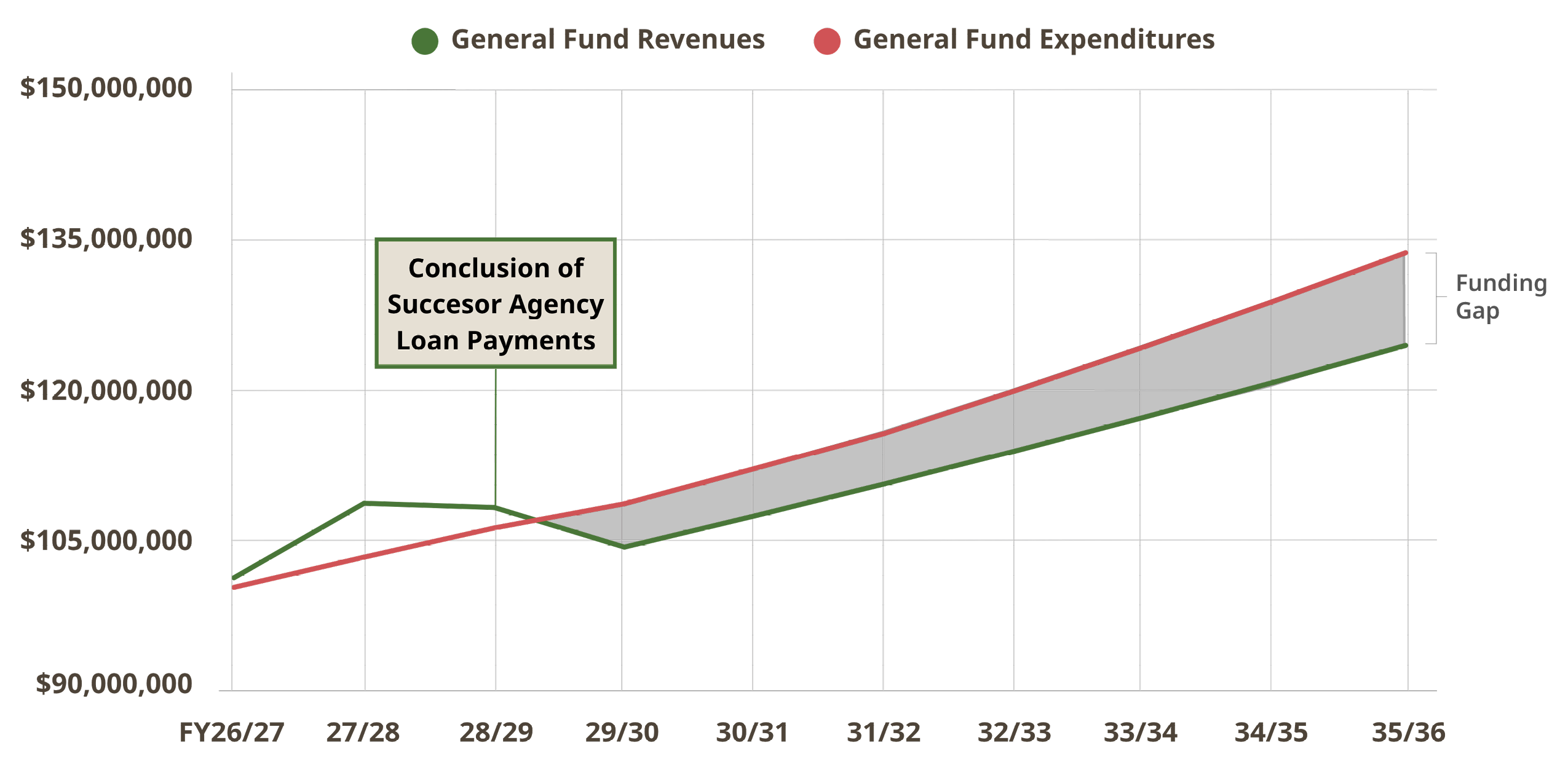
General Fund expenditures are projected to outpace General Fund revenues over time, resulting in recurring structural deficits. 

Line graph displaying 10-Year Forecasted Expenditures and Revenues

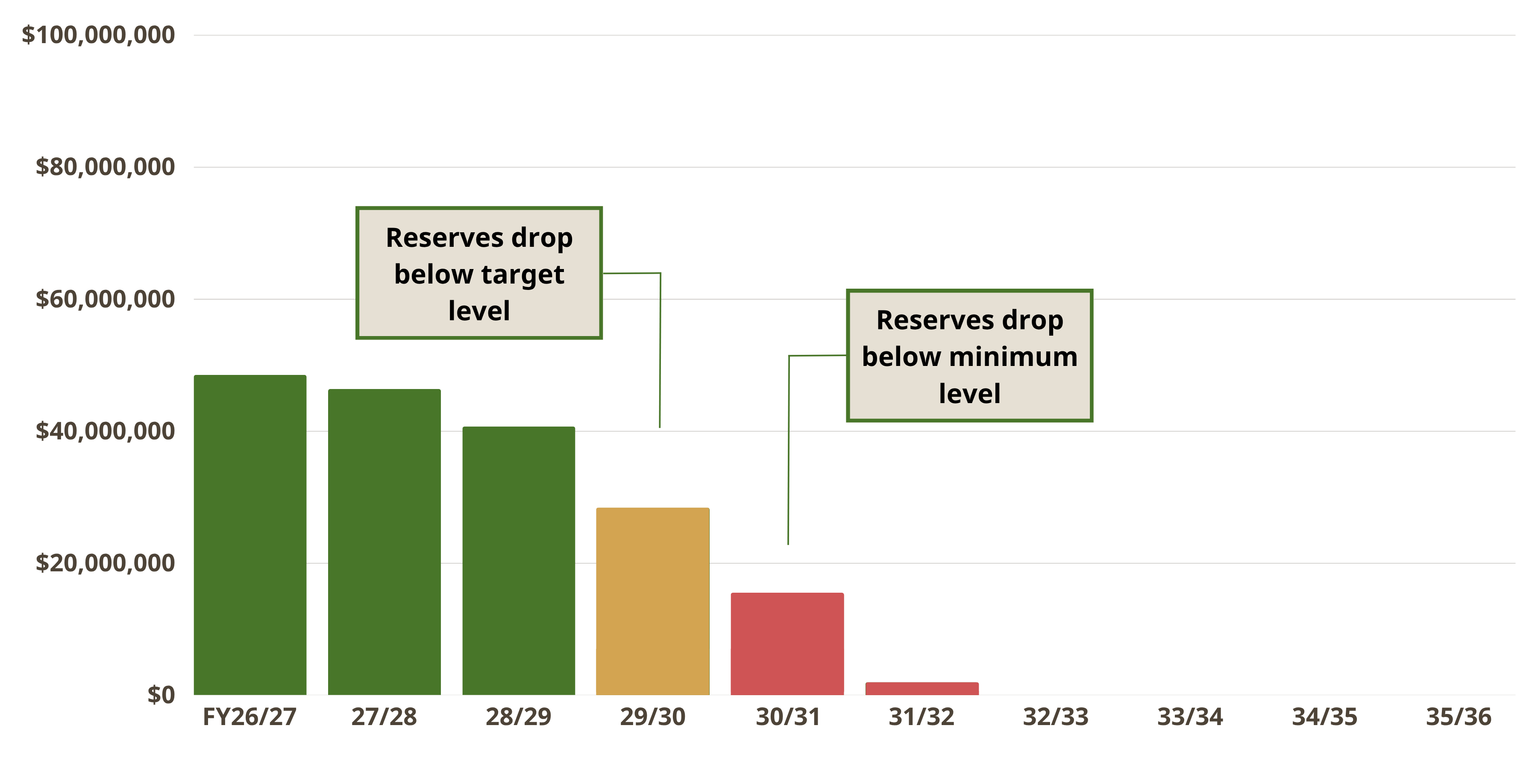
General Fund reserves are declining steadily and are projected to fall below the City's minimum reserve policy threshold within the forecast period. As reserves diminish, the City's flexibility to fund capital improvements, address infrastructure needs, and maintain current levels of service becomes increasingly constrained.

Bar chart displaying 10-Year Forecasted General Fund Reserves

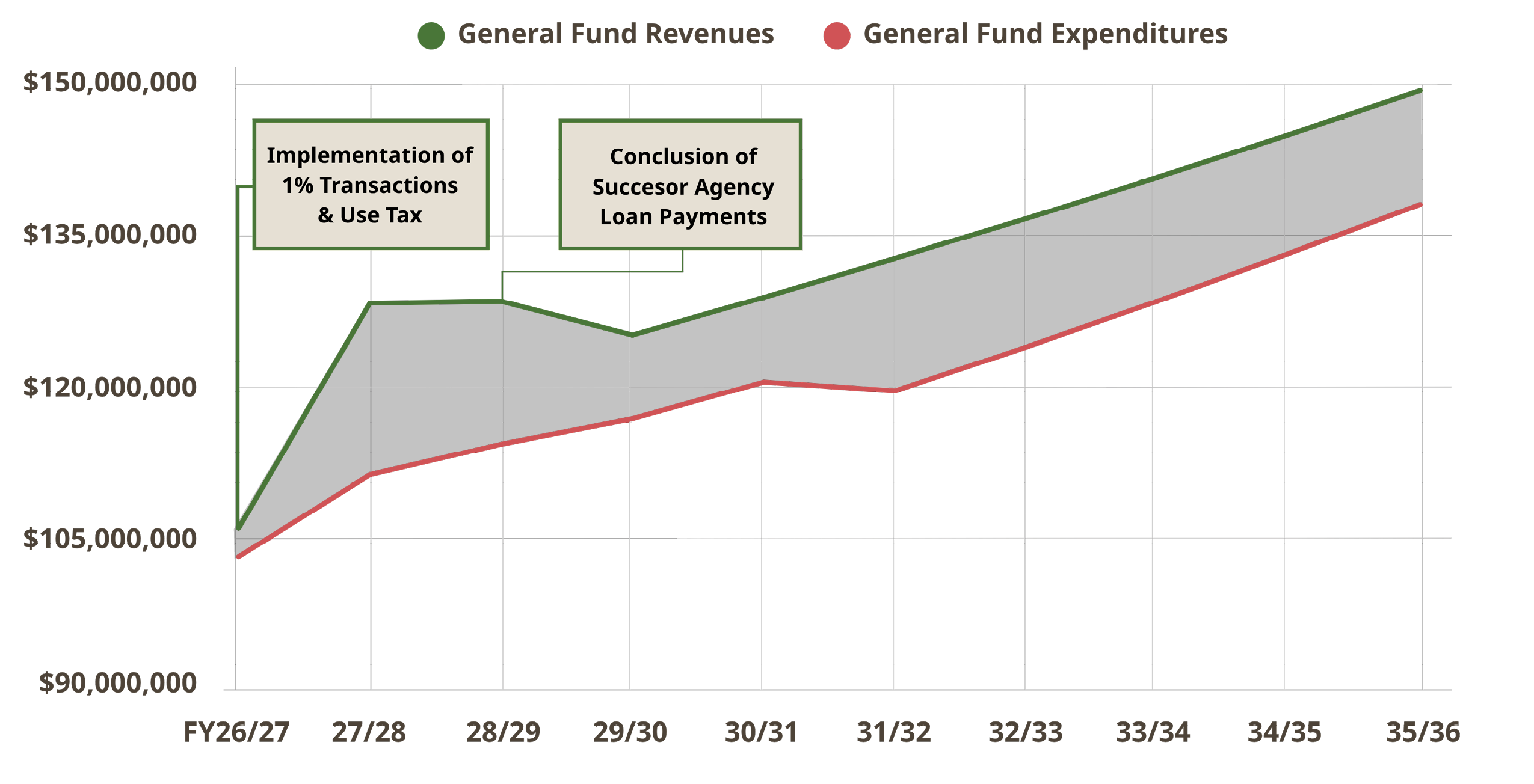
A Transactions and Use Tax (TUT) increase of 1% is projected to raise General Fund revenues by approximately $19 million annually. This would enhance the City's fiscal capacity, helping to close General Fund deficits. Implementing a TUT would require voter approval. 

Line graph displaying Forecasted General Fund Expenditures and Revenues (With 1% TUT)

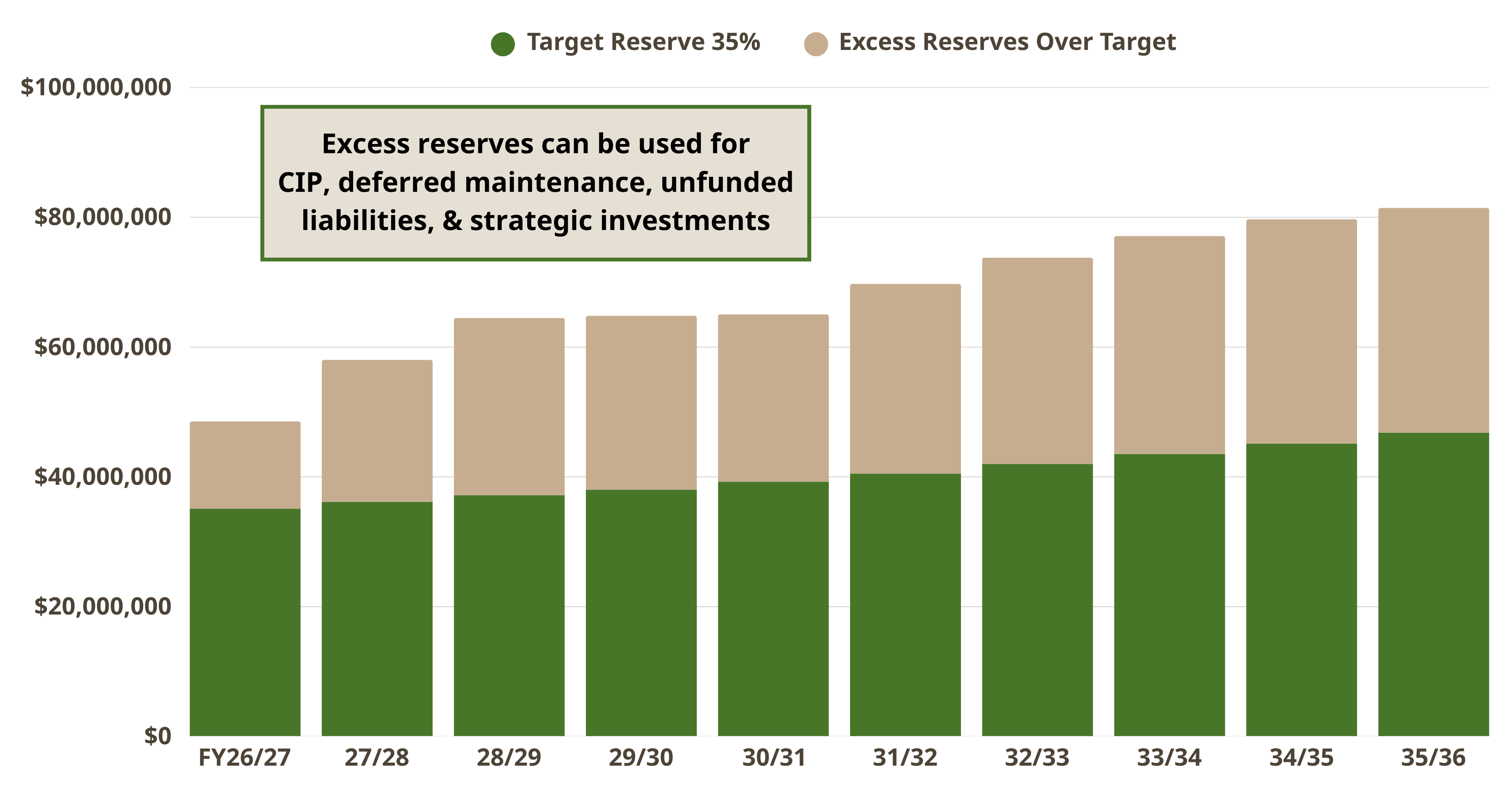
Approval of a 1% TUT increase would support growth of the City's General Fund Reserves. Over time, this would enable the allocation of reserves toward capital investment and strategic one-time expenditures. (The chart below assumes cumulative reserve growth for analytical purposes and does not reflect spending of excess reserves.)

Bar char displaying Forecasted General Fund Reserves (With 1% TUT)


Frequently Asked Questions

The questions and answers listed below are a combination of feedback received as part of the City's RBTF meetings, Community Budget Workshops, and engagement with City staff. 

Jump to FAQ topics:
Fiscal Climate | Expenditure Reductions | Revenue Options | Other Questions

Fiscal Climate

FAQs on the City’s current financial situation and budget development process.  

The need for adjustments is driven by both declining revenues and increasing costs. On the revenue side, the City is experiencing a reduction in both current sales tax and forecasted sales tax revenue, as well as reductions in other revenue areas. On the expenditure side, the City is facing increased costs for services, rising material costs, and higher expenses related to salaries, pensions, and employee benefits. These combined factors are creating a structural imbalance that requires the City to evaluate service levels and align spending with existing revenue in order to maintain long term fiscal sustainability.


A dual budget framework allows the City Council to consider adoption of either a primary budget scenario, which is developed within the City’s existing revenue parameters, or a contingent budget scenario, which includes the assumption that a 1% sales tax is passed. City staff has prepared both budget scenarios. The first scenario assumes no new revenue and includes significant expenditure and service reductions to maintain fiscal sustainability. The second assumes the passage of a 1% Transactions and Use Tax (local sales tax) measure, which would generate approximately $19 million in new annual revenue and allow the City to maintain current service levels.

The City collects revenues through multiple methods which are distributed to different fund types. Those funds pay for services to support Cerritos residents, businesses, and visitors.  The General Fund is the City’s primary operating fund, with nearly half of the fund accounted for by sales tax revenues. Other revenue sources include Enterprise Funds, such as the Water Fund and Sewer Funds. These funds are primarily supported by user fees, and the revenue they generate is restricted to their specific purposes. This means that water and sewer revenues cannot be used for General Fund activities.

The City of Cerritos defines a balanced budget through its Strategic Financial Plan and Budget Preparation Policy, approved by the City Council in November 2023. The Policy states that a “balanced budget exists when ongoing operating revenues are equal to or exceed ongoing operating expenditures.” Based on this definition, a budget deficit would occur if ongoing expenditures exceed ongoing revenues. The City’s preliminary Fiscal Year 2026–27 budget is considered balanced, with approximately $132.9 million in ongoing revenues and $127.5 million in ongoing expenditures, resulting in a surplus of about $5.4 million. Ongoing revenues include sources such as sales tax, property tax, and investment income, while ongoing expenditures include recurring costs like salaries, maintenance, and supplies. One-time investments such as new facilities or major capital infrastructure projects are not included in the operating budget, yet require substantial annual General Fund support.  

While the operating budget is balanced, when viewed in totality (operating and capital improvement expenditures), the City’s overall expenditure of $151.7 million will only be partially offset by the $145.7 million in forecasted combined revenues (recurring and one-time), resulting in an overall deficit of $6 million.

The City’s Financial Reserve Policy establishes a target reserve level of 35% of General Fund expenditures, with a minimum threshold of 25%. This approach is consistent with best practices and is particularly important given that some of the City’s revenue streams are more volatile than those of cities that rely more stable sources of revenues such as property taxes.

Excess reserves—defined as any funds in excess of the reserve target established for each fund —are distributed at the end of the fiscal year in accordance with City policy. Of these funds, 50% is allocated to the Municipal Improvement Capital Project Fund to support capital projects, until the reserve target is fully funded, 35% is directed toward unfunded liabilities, including pension liabilities, which will be addressed through Additional Discretionary Payments (ADP) to CalPERS, and other Post-Employment Benefits (OPEB) liabilities, which will be funded through contributions to an OPEB trust. The goal is to achieve at least 90% funding for both plans, as determined by the most recent actuarial valuations, and the remaining 15% is allocated to strategic one-time projects as recommended by the City Manager and presented to the City Council for approval.  

Reserve funds are typically set aside to help the City respond to economic disruptions, emergencies, or temporary financial challenges.  In the case of a water well failure, General Fund reserves are available to address the issue and can be used accordingly. 

While General Fund reserves can be used to address Enterprise Fund-related issues, this is not considered a best practice, as Enterprise Funds are intended to be wholly self-sustaining and should maintain sufficient reserves to address maintenance and emergency repairs. 

Capital Improvement Program (CIP) funds are used for major, long-term investments in City infrastructure and assets, such as repairs and improvements to roads, parks, facilities, and other public amenities. The City maintains a five-year list of proposed CIP projects, which is reviewed annually as part of the budget process to prioritize projects and determine available funding. As part of this process, projects are evaluated based on factors such as impacts to public safety, regulatory requirements, and the availability of external funding. The City also seeks to maximize the use of external funding sources, including county and state programs, to supplement local funds.

Much of Cerritos’ infrastructure was originally built during the City’s early development in the 1960s and 1970s, which means many facilities, streets, and amenities are now 50-60 years old . Following the dissolution of redevelopment in 2011, a significant portion of major maintenance was deferred, which has contributed to a growing backlog of needed improvements.

The City is currently finalizing a comprehensive Facility Condition Assessment (FCA), which provides a clearer picture of these needs. Preliminary estimates identify approximately $140 million in facility and park-related maintenance and repairs, $70 million in road repairs and replacements, $8.8 million for citywide tree replacement, and $6.3 million for playground equipment replacement over the next 10 years. In addition, the City is completing a citywide Americans with Disabilities Act (ADA) assessment, which will identify further costs to address accessibility improvements; those costs are not yet quantified. While these needs are not fully reflected in the current budget, the City will need to plan for and address them over time to maintain safe, accessible, and reliable infrastructure.

Redevelopment in California was a State-initiated program designed to give local   governments a tool to address urban blight and promote economic development within designated project areas. Established under California law, it relied on a mechanism known as tax increment financing, which allowed local agencies to capture the growth in property tax revenues generated by rising property values within redevelopment project areas and reinvest those funds into infrastructure, affordable housing, and other revitalization efforts. This tool was widely used by cities across the state.

Recognizing its potential early on, City leaders began using redevelopment in the 1970s to help develop and maintain many of the facilities and amenities residents enjoy today. By 2011, the City was receiving approximately $30 million annually in redevelopment revenue, which was largely dedicated to infrastructure maintenance and improvements.

However, despite its long-standing role in supporting local development, the State dissolved redevelopment agencies in 2011. With the exception of funding for outstanding obligations of the Redevelopment Agency, which is managed by the Successor Agency to the Cerritos Redevelopment Agency, this resulted in the City’s immediate loss of a $30 million annual funding source. As a result, the City was forced to identify alternative funding sources to support ongoing infrastructure needs. Over time, the loss of redevelopment funding has contributed to the City’s current fiscal challenges, where existing revenues are no longer sufficient to keep pace with rising expenditures, requiring difficult decisions about service levels and potential identification new revenue sources.

There are two remaining loan repayments to the City, $12.9 million for Fiscal Year 2027-28 and $8.7 million for FY 2028-29. After that, this significant but temporary revenue source for the City’s General Fund will end, and the City will no longer receive this revenue. 

Background: Redevelopment in California ended in 2011, when the State dissolved all redevelopment agencies. Since then, the City of Cerritos has served as the Successor Agency responsible for winding down the former Cerritos Redevelopment Agency’s financial obligations.

As part of this process, the Successor Agency has been repaying a long-standing loan the former Redevelopment Agency owed to the City. These repayments come from the Redevelopment Property Tax Trust Fund and are approved through the State-reviewed “Last and Final” Recognized Obligation Payment Schedule (ROPS). The balance of the loan will be fully repaid during Fiscal Year 2028-29. 

The City’s pension liability, known as the CalPERS Unfunded Accrued Liability (UAL), has developed over time due to a combination of factors, many of which are outside of the City’s direct control. These include periods of lower-than-expected investment returns by CalPERS and changes in actuarial assumptions, such as longer life expectancies and updated financial projections. While the City has consistently made its required annual payments toward this liability, those minimum payments alone are not sufficient to significantly reduce the overall balance over time.

To address this, the City is establishing a Pension Stabilization Fund in accordance with its Financial Reserve Policy. This fund will dedicate a portion of the General Fund’s unassigned balance specifically toward reducing the pension liability, reflecting a proactive and disciplined approach to long-term financial management and helping to ensure continued progress in addressing this obligation.

The City’s required annual payments toward its unfunded pension liability, also known as the Unfunded Accrued Liability (UAL), are included within employee benefit costs in the operating budget. The City’s required UAL payment for the upcoming fiscal year is projected to be approximately $9 million.  In accordance with the City’s reserve policy, the City has the ability to make supplemental payments toward this liability in years when revenues exceed expenses, which can help reduce long-term costs.

Expenditure Reductions

FAQs on existing City expenditures and potential expenditure reductions to balance the budget. 

The City is evaluating a wide range of potential reductions. To guide this process, consideration is being given to the goals in our Strategic Plan, along with feedback from the Resident Budget Task Force, the broader public, and direction from City Council. 

The no-new-revenue budget scenario includes a series of operational and service level adjustments to reduce costs while maintaining essential services. These measures include implementing a one-day-weekly closure of Community Centers, the Senior Center, Swim Center, and Library (which would continue to maintain its current one-day closure), as well as closing City Hall, Community Safety, and the Corporate Yard on alternating Fridays. The City would also implement a limited hiring freeze, suspend or modify City special events and ceremonies, and reduce the number of shows presented at the Cerritos Center for the Performing Arts by approximately 20%. Additional proposals include suspending the Sky Knight helicopter patrol program, suspending vehicle fleet replacement, minimizing the Capital Improvement Program budget to focus on essential and high priority projects, and eliminating overnight travel for training and conferences for City staff. For more information, view the agenda report for the May 11 City Council meeting. 

Vacant positions will be carefully evaluated before recruitment proceeds. Determinations regarding filling of vacant positions will be based on factors such as legal requirements, staffing levels, revenue impact, and alignment with core City services.


The impacts of weekly facility closures on employees will first be discussed with the Union through a meet and confer process. Following that process, City leadership will provide guidance on schedules and staffing adjustments. The intent is to reduce operating costs while continuing to provide core services.  For employees assigned to impacted facilities (particularly part-time employees), any reduction in facility operating hours will have a direct impact on, and reduction of, their working hours.

The City is evaluating options and developing a plan. Closures may be staggered based on operational considerations. Changes affecting represented employees will be subject to legally required labor negotiations.

Capital projects deemed high priority and/or funded through outside sources (not funded through the General Fund) will move forward. Project prioritization will follow the City’s Capital Improvement Program policy and will be based on considerations that prioritize public safety, compliance with regulatory requirements, alignment with the City’s Strategic Plan, and availability of external funding.

The City is proposing to reduce the number of shows it directly presents at the Cerritos Center for the Performing Arts by approximately 20%.  The proposed reduction in the presentation of performances will have a direct impact on those employees assigned to staff and facilitate theater performances and will result in a reduction of employee working hours.
 
From an operational standpoint, the City is focusing on an  increased emphasis on theater rentals. This is part of a broader strategy to reduce General Fund support to the Theater and better offset operating costs by increasing revenues through ticket sales, rentals, sponsorships, and donations. The City is also pursuing initiatives to strengthen long-term financial sustainability, including an economic impact study, the creation of a non-profit arm to secure private donations and sponsorships, and development of a tiered membership program.

The City has historically sought to replace and maintain trees to maintain its park-like environment, which makes Cerritos a desirable place to live and work.  For many residents, parkway and median tree maintenance is a high priority. A reduced tree replacement and maintenance program could be considered, but doing so has the significant potential to create additional impacts to sidewalk, curb and gutter, street maintenance, among other impacts.  

Many of the potential reductions and cost containment measures incorporated into the proposed budget were presented to, and discussed with, the Resident Budget Task Force (RBTF) as part of the City’s budget review process. The proposed budget reflects several of the concepts and recommendations evaluated by the RBTF in an effort to balance fiscal responsibility while maintaining core City services.  In addition, the budget includes several operational and internally focused reductions related to  staff training, custodial services, traffic studies, and other administrative and operational needs.

Revenue Options

FAQs on revenue considerations to balance the budget. 

The current sales tax rate in Cerritos is 9.75%. 

The City of Cerritos is projected to generate $43.8 million in sales tax revenue during the 2025-2026 Fiscal Year. Sales tax is one of the community’s main funding sources, helping support essential services such as public safety, street maintenance, parks and community programs. Residents and visitors alike contribute to the City’s sales tax revenues. 

The City reports on sales tax performance quarterly as part of its budget reporting process, including a breakdown of revenue by major industry categories. This information provides insight into key contributors such as auto sales and commercial activity from the City’s shopping centers, as well as other sectors, while maintaining taxpayer confidentiality. The most recent report can be found through this link.

Cerritos is considered a “no-low property tax” city, meaning the City receives a smaller share of property tax revenue than surrounding cities. As a result, the City relies on other revenue sources, such as sales tax and fees, to support essential services for the community. 

The City has evaluated a range of potential revenue options as part of its ongoing budget and financial planning efforts. This analysis, presented to the City Council on March 9, has included a possible Utility Users Tax, a Transactions and Use Tax (Sales Tax), an increase to the Transient Occupancy Tax (Hotel Bed Tax), parcel taxes, property transfer taxes, and expanded pursuit of grant opportunities. Each option has different legal requirements, revenue potential, and community impacts. The City Council has directed staff to further explore an increase to the Sales Tax while continuing to assess other options.

A TUT, commonly referred to as a local sales tax, applies to taxable retail transactions for some goods and services occurring within the City and to certain purchases allocated through the countywide use tax pool. Adoption of a TUT would require direction by the City Council to place the item on a ballot.  If the City Council directs a sales tax to be placed on the ballot, the measure would require approval by a simple majority of voters to be adopted.

Estimates prepared by the City’s sales tax consultant, HdL Companies, project that a 1% TUT would generate approximately $19 million annually for the City. More than half of that new revenue would be generated by non-residents who visit Cerritos to shop and dine.

If the City pursues, and the voters approve, a TUT Cerritos’ sales tax rate would become 10.75%. Of that amount, the City will receive 2% in sales tax revenue on most purchases.  

Under State law, the City may use general revenues, such as sales tax, to support its water fund; however, the reverse is not allowed—water and sewer funds cannot be used to subsidize general City operations. If a sales tax measure were approved, the proposed budget currently includes a $50 bi-monthly credit for Cerritos water customers to help offset costs associated with capital improvements in the water system. This approach would help reduce the financial impact on ratepayers while maintaining necessary investments in infrastructure.

If placed on the November 2026 ballot and approved by voters, the measure would take effect in spring, 2027. Because the tax would only be in place for a portion of the 2026-2027 fiscal year, the City would receive revenue for approximately one quarter of the year. This would limit the ability to make immediate large-scale restorations. Full details of what would be restored in the first year can be found in the May 11, Budget Study Session agenda report.

Sales tax is not the only solution available to the City of Cerritos. However, without additional revenue, the City’s constrained fiscal position will persist and will require ongoing and compounding budget cuts and service reductions to address. A 1% TUT was among several alternative revenue sources introduced by City staff at the March 9, 2026, meeting, at the direction of the City Council. Among the alternatives evaluated, a 1% TUT would generate substantially greater ongoing revenue than the others, with non-residents accounting for a majority of the revenue received. Conversely, the other revenue measures (such as parcel taxes or utility user taxes) would place the full tax burden on Cerritos residents.

In California, local governments can add voter-approved sales taxes on top of the Statewide base sales tax rate of 7.25%, but California law caps these local add-on taxes at 2.00% within any given jurisdiction. This means that, in most cases, the combined rate of all city, county, and special district sales taxes placed on top of the 7.25% Statewide base cannot exceed an additional 2%.
 
However, this limit is not absolute. The State can grant specific exemptions, through legislative authorizations, to allow jurisdictions to exceed the 2% cap. As a result, some areas in California (such as Los Angeles County) have combined local add-on rates above 2%, leading to total sales tax rates that surpass what would otherwise be the sales tax cap.

In Cerritos, the current sales tax rate is 9.75%, which means that there is an additional 2.25% in taxes that have been initiated by agencies with the ability to levy a sales tax in the City. All of the additional taxes have been initiated by Los Angeles County agencies for projects such as transit improvements and homeless services and programs.  These measures have been approved by the voters of Los Angeles County and are in effect in Cerritos.  Of the 2.25% additional tax, Los Angeles County has obtained legislative exemptions for 1.25% - meaning that there is an additional 1% of sales tax cap space available in Cerritos to local taxing agencies (this would include, among others, Los Angeles County, Los Angeles County Fire, or the City itself) for additional sales tax measures. 

The revenue assumptions reflected in the City’s analysis are based on a November 2026 election. It is important to note the potential opportunity cost associated with placing a TUT ballot measure on the November 2026 ballot, as opposed to the March 2027 ballot. Delaying consideration of the measure until March 2027 would result in the loss of approximately $9 million in projected new sales tax revenue, if the measure was to be approved.  

The City Council has the authority to place a measure on its regularly scheduled election cycle date. The next such date for Cerritos is March 2027. Placing a potential 1% TUT on the November 2026 ballot can only be done under special circumstances. In this instance, the City Council would first need to declare a fiscal emergency. This declaration could potentially be supported by the City's structural budget imbalance, the scale of service reductions under consideration, the growing costs associated with maintaining core infrastructure and services, and the upcoming expiration of Recognized Obligation Payment Schedule (ROPS) revenues in the following fiscal year. 

The exact cost depends on fees charged by the County; however, it is estimated to cost approximately $250,000 to place a measure on the ballot as part of a special election in November 2026, consolidated with the County-administered Statewide General Election.

The City has evaluated a variety of operational models utilized by performing arts venues throughout the country, including third party management and outsourcing arrangements used by some municipalities. In 2017, the City issued a Request for Proposals (RFP) to explore the potential outsourcing of operations at the CCPA. However, the City did not receive any responsive proposals in response to the RFP.  

At this time, the City is not pursuing the outsourcing of operations at the CCPA, and the proposed budget does not include transferring management of the facility to a third party operator. Instead, the budget reflects operational adjustments intended to improve financial sustainability, including a planned 20% reduction in Cerritos presented shows and an increased focus on rental opportunities. Rental events provide more predictable revenue through guaranteed income arrangements, which reduces the City’s financial exposure to potential losses associated with City programming while continuing to support use of the facility.

The City is routinely evaluating options for additional revenue. At the CCPA, the City continues to actively pursue sponsorship opportunities and is in the process of creating a non-profit arm to expand the Theater’s ability to access donations and grants.  To reduce operating and capital improvement expenses the City received a $2 million gift-in-kind sponsorship from a prominent audio systems purveyor. The City will continue to work to achieve these kinds of operational efficiencies that reduce expenditures, while simultaneously working to maximize the revenue generating potential of the CCPA.

The City has a dedicated economic development liaison within the Community Development Department who actively works to support both new and existing Cerritos businesses. The City is also preparing an Economic Development Strategic Plan that will be used to guide the City’s future economic development efforts. The City is continually working to attract and retain businesses that are valuable to the community, both in terms of the services they provide and revenue they help to generate.

The City owns the land on which the majority of City facilities and parks are located.  The City also owns the revenue generating land of the Cerritos Towne Center, the Lincoln Station Shopping Center, as well as commercial properties in the Cerritos Auto Square and industrial properties within the Cerritos Industrial Park. These properties are a significant source of revenue to the City through the ground lease revenue that they collectively generate.

The City of Cerritos is not heavily reliant on federal funding for its day-to-day operations, so recent federal cuts have had a relatively limited direct impact. However, the City does receive approximately $200,000 annually through Community Development Block Grant (CDBG) funding, which has been used for projects such as converting playground surfaces to rubberized materials for improved accessibility and upgrading curb ramps to meet ADA requirements. The City also actively pursues competitive federal funding opportunities when available, including successfully securing approximately $8 million for the Del Amo Boulevard Bridge renovation project. While federal funding is an important supplemental resource for specific projects, the City’s core services are primarily supported through local revenue sources.

Other Questions

The City Council directed the City Manager to form the Resident Budget Task Force.  As directed, the City Manager worked to convene a task force that was a representative cross section of members of the community and included residents with a wide variety of perspectives. 

As reflected in the Fiscal Year 2025–26 budget, the City has 229 full-time positions and approximately 176.2 full-time equivalent part-time positions. The City regularly evaluates staffing and compensation to ensure alignment with service needs and fiscal responsibility, including a recent Citywide classification and compensation study that set salaries at approximately the median of comparable cities. 


Ground leases are typically structured with long terms due to the significant upfront capital investment required to develop the properties. As a result, they serve as stable, long-term revenue sources for the City. Rather than being frequently renegotiated, most ground leases include built-in rent adjustments—often tied to the Consumer Price Index (CPI) or similar measures—to ensure revenues keep pace with market conditions over time.

The City contracts with Southwest Patrol at a cost of approximately $25,000 per month to provide additional public safety support. This service was implemented in response to concerns about residential burglaries, which were identified as a priority by the City Council. Southwest Patrol provides a visible presence in residential neighborhoods and operates in an observe-and-report capacity, working alongside existing law enforcement efforts. Since implementation, the City has experienced a year-over-year reduction of approximately 40% in residential burglaries.

Information regarding City Council and employee compensation and benefits is available on the City’s website at cerritos.gov/jobs, where detailed information outlining compensation and benefit structures can be viewed.

For More Information

Visit the Budget and Finances webpage, or contact the Finance and Budget Division by calling the Administrative Services Department at (562) 916-1355 or submit a notice through the online form

Jump to: Top of page